One crew or many subs? Builder accountability for Austin outdoor kitchens
The most common way an outdoor kitchen goes wrong in Austin is not bad materials or bad design. It is a chain of separate crews, each of which did its own part acceptably and none of whom owns the finished result. The commercial playbook behind this article compares two models directly: a fragmented local subcontractor chain, and a unified, owner-supervised specialty team. The difference is not price on the proposal. It is who is accountable when something is wrong.
The deck's warning is specific. Relying on scattered local subcontractors introduces quality control gaps and schedule overruns, and a unified, owner-supervised specialty team delivers precision and total accountability from demolition through final finish. For a homeowner in Cedar Park or a small commercial operator with a patio to open, that distinction decides the outcome.
How the fragmented model fails
In the fragmented model a general contractor sits at the top and stacks separate plumbing, prep and finish crews beneath. Each crew is usually competent. The problem is the interfaces. The plumbing crew sets its penetrations, then leaves. The prep crew arrives and works around whatever it finds. The finish crew never sees either one and has no authority to redo what it did not build.
Three predictable failures follow. Scheduling conflicts appear as delays, because every crew is juggling multiple jobs and your project is not their priority. Communication breaks down at exactly the moment a decision matters, because nobody at the top has been on site. And when something does go wrong, blame moves sideways - the classic finger-pointing that leaves the owner paying for a repair that is nobody's responsibility.
The two models side by side
| Dimension | Fragmented local model | Unified supervised team |
|---|---|---|
| Accountable parties | A general contractor above separate plumbing, prep and finish crews | One certified specialty team, one point of accountability |
| Schedule risk | Delays and scheduling conflicts between trades | Rapid deployment - the crew is the schedule |
| Supervision | Communication breakdowns between trades | Owner-level supervision on site, start to finish |
| When defects appear | Finger-pointing between crews | Zero-defect scope: the same team returns |
| Warranty standard | No stated term; tied to whichever crew is still trading | 40-year standard behind supervised execution |
The last row is the one to read twice. A 40-year standard is not a promise about luck. It is only credible if one organisation controls the structural work, the waterproofing, the penetrations and the finish - in other words, if the interfaces that the fragmented model leaves unowned are owned by someone. A warranty from a chain of independent crews is effectively a warranty on whichever link happened to fail.
Why this matters more outdoors than indoors
Indoor trades work in a controlled envelope. Outdoors, every interface is exposed: penetrations see water, edges see freeze-thaw, surfaces see UV. The number of failure points is higher, and the cost of a handoff error is higher, because water that gets into the wrong place does damage for months before anyone notices. That is precisely the condition the commercial playbook assumes, and precisely why hospitality operators use single-team deployment.
The same logic applies at residential scale. A single owner-supervised crew that stays from demolition to final polish eliminates the three failure modes at once: no scheduling conflict between trades, no communication gap at a decision point, and no ambiguity about who fixes a defect. If the base is audited first - see what a structural audit covers - the whole scope sits with one party.
Cost comparison is where the two models look most similar and behave most differently. A fragmented proposal often prices lower because each trade quotes only its own work, and nobody carries the cost of the interfaces between them: the sleeve that has to be re-sealed, the edge that has to be re-detailed, the return visit that is nobody's line item. Those costs do not disappear. They arrive later, unbudgeted, which is why the fourth question to ask is not what the job costs but what the scope includes at each interface.
Questions to ask a builder before signing
Ask who physically performs the structural work, the waterproofing, the plumbing penetrations and the finish. If the answer names different companies, ask who supervises their interfaces and who signs the warranty for all four. Ask whether the finish applicator is recognised by the material manufacturer, since a substituted or unrecognised applicator can void protection entirely - the mechanics are in the material authentication guide. Finally, ask what the warranty term actually is, in years, and who is legally behind it.
Those four questions separate a coordinated build from a stack of independent ones. They also change your own role: with a single team you review decisions, not chase trades. Our tools hub has the decision funnel for sequencing those decisions and the cost calculator for comparing single-team and multi-trade quotes on equal terms.
Frequently asked questions about builder accountability
Is a general contractor the same as a supervised specialty team?
Not necessarily. A general contractor can be excellent and still manage a chain of independent crews. The difference is whether the interfaces between trades are owned by someone on site, and whether one party carries the warranty across all of them.
Does single-team deployment cost more?
The proposal may look higher and the total often is not, because delays, rework and disputed defects are the costs that show up later. Compare quotes on the same three-part scope described in the Austin cost breakdown.
What does owner-level supervision mean in practice?
That the person responsible for the outcome is on the property during the work, not relaying messages between crews. On structural and waterproofing stages especially, that presence is what prevents the handoff errors the deck warns about.
Pick one accountable team
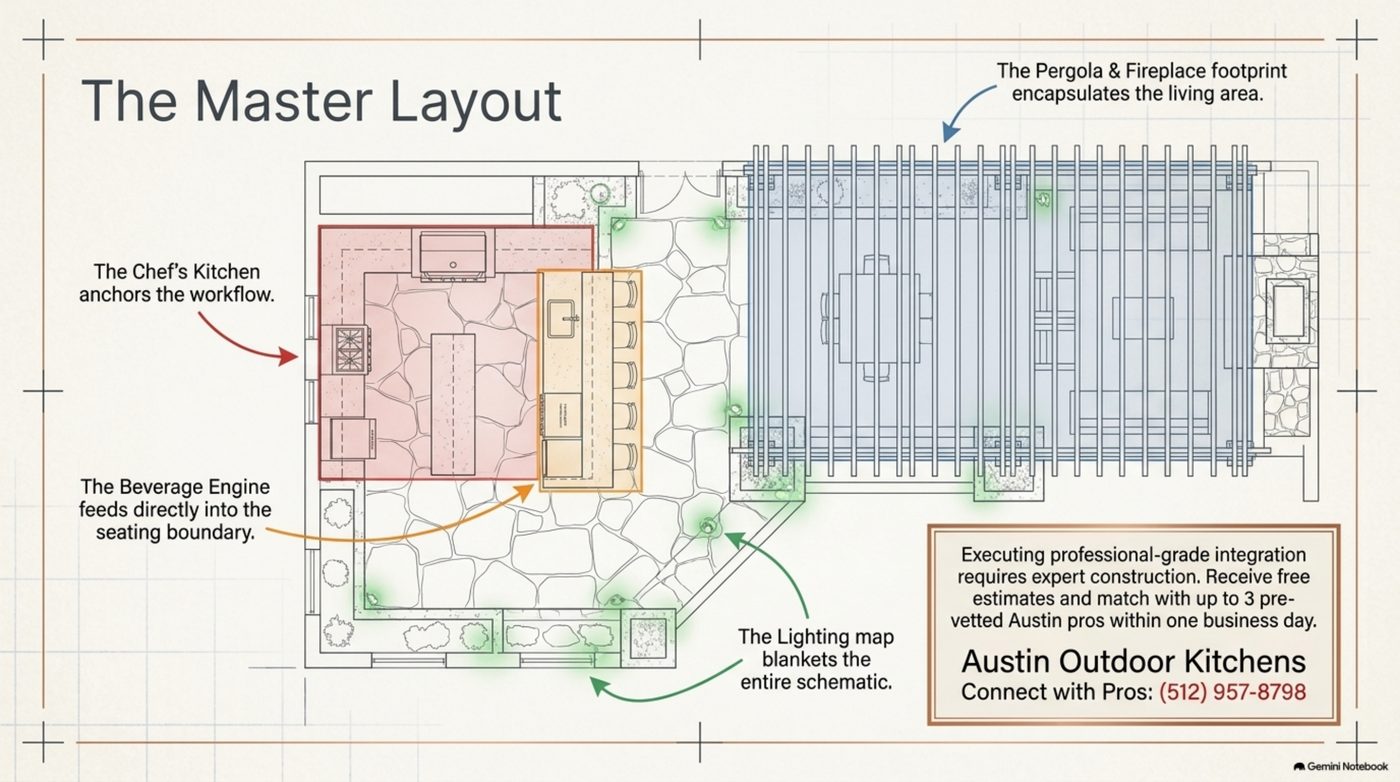
The commercial playbook's comparison is not really about local versus travelling crews. It is about whether accountability has one address. For an Austin project, that means one team, one supervisor and one warranty across structure, waterproofing and finish. Call (512) 957-8798 to talk through a single-team scope, or start with the outdoor architectural master plan to define the work before you ask for it.