The structural audit: what sits under your Austin outdoor kitchen
Surface cracks are almost always a symptom, not the problem. The commercial playbook behind this article states it plainly: aesthetic surface cracks usually signal underlying substrate failure, and applying a new finish over a compromised foundation guarantees a shortened lifespan and a rapid relapse. An Austin outdoor kitchen that cracks every other summer is not unlucky. It is telling you something about the layer underneath.
The fix is an audit, and an audit is just an ordered list of things to inspect. This article takes the deck's substrate anatomy - the concrete base, the waterproof layer, the plumbing penetrations and the final aggregate finish - and turns it into a checklist you can hold a builder to.
The four layers, top to bottom
The deck's anatomy diagram is drawn as a stack, and reading it from the bottom up is the correct order of diagnosis. The concrete base carries everything. The waterproof layer keeps water out of that base. The plumbing penetrations are the deliberate holes through both, and they are where water gets in. The aggregate finish is the visible topcoat that protects the assembly and takes the wear.
When this stack is built in order, a finish lasts. When it is built out of order - finish first, base last, penetrations improvised on the day - the finish becomes a temporary lid over an active problem.
The audit checklist, with the deck's own detail
| Layer | Its job | Failure symptom | What the audit does |
|---|---|---|---|
| Concrete base | Carries the full dead and live load | Movement, hollow sound when tapped, cracking that returns | Establishes whether the shell is sound before anything decorative is ordered |
| Waterproof bonding layer | Stops water reaching the base | Damp patches, efflorescence, finish lifting in sheets | Confirms an impermeable barrier, in the deck's words a mathematically sound foundation |
| Plumbing penetrations | Deliver water and drain waste | Staining and rot concentrated at the back of the counter | Checks every sleeve and seal, the most common leak path |
| Final aggregate finish | Protects the stack and takes the traffic | Chalking, colour loss, pattern cracking | Assesses remaining life rather than reacting to the first stain |
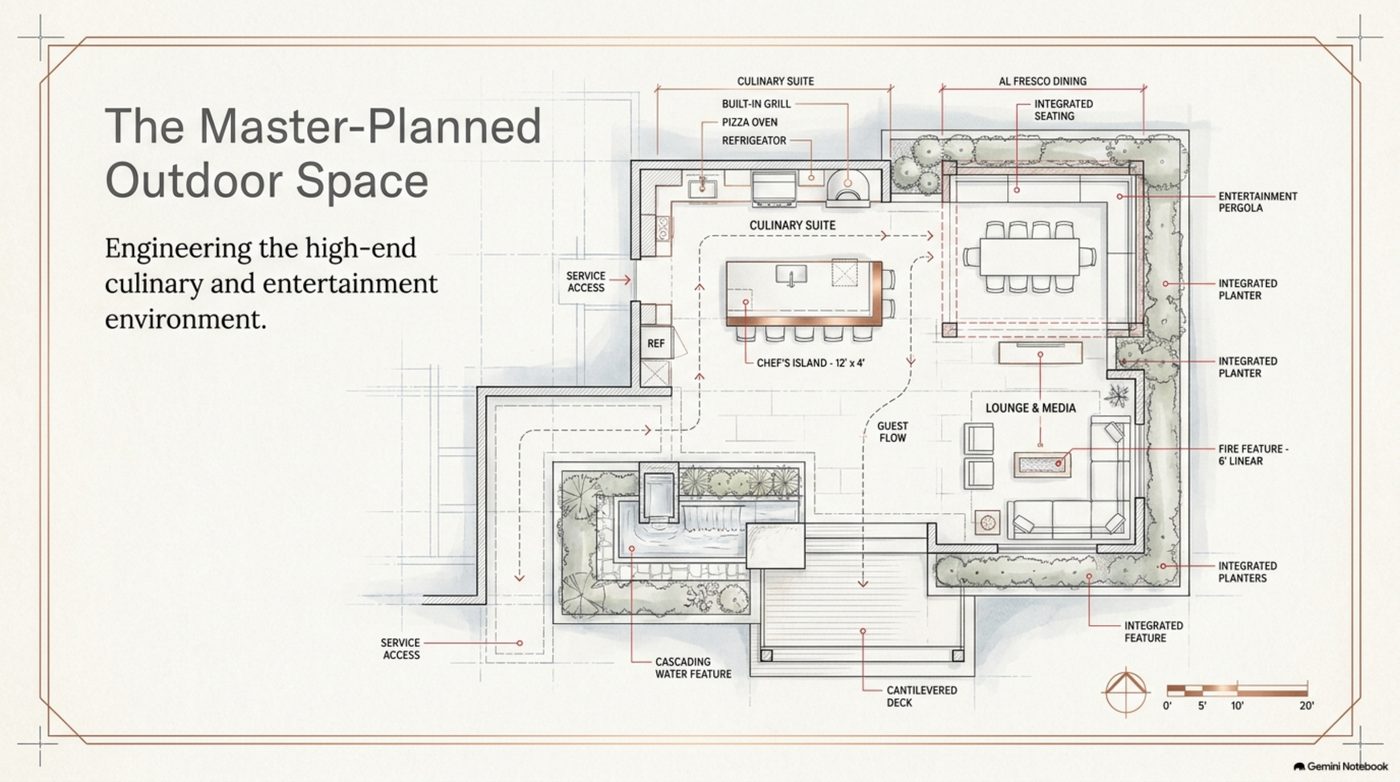
Two figures from the deck's plan belong in the same conversation. The drawn grid sets a repeating 3,500 mm bay and a 5,060 mm overall run, with a 100 mm edge detail at the slab boundary and a contour line at +10.00. In an audit those are not trivia. The module tells you how the structure was meant to repeat, the edge detail tells you where water is supposed to stop, and the contour tells you which way it was supposed to run. If the as-built condition disagrees with the drawing, you have found the crack's origin.
Why the waterproof layer gets missed
It is the only layer nobody sees. The base is underneath, the finish is on top, and the penetrations are at the back where nobody stands. A builder who skips or rushes the waterproof layer produces a structure that looks correct for a season and then fails from the inside. On Austin properties the failure is usually first noticed as staining or lifting after a hard freeze, which is precisely the mechanism the playbook describes: water in, expansion, surface loss.
What an audit changes about the quote
An audited scope has three parts instead of one: corrective structural work, the waterproofing and penetration detailing, and the finish. That structure makes the quote comparable. Two builders quoting a single "rebuild the counter" line are not quoting the same job. Two builders quoting the same three-part scope are, and the numbers can be compared honestly - see the Austin cost breakdown for how those parts usually split.
It also changes the warranty conversation. Structural work that is documented is warrantable. Cosmetic work over an unknown base is not, in practice, because nobody can prove what was underneath. Fixing that is the entire point of the supervised-standard approach described in the builder accountability guide.
Running an audit yourself before you hire
You do not need equipment to do a first pass. Walk the perimeter and look for any place soil or mulch sits against the base. Tap the counter and listen for a hollow tone. Trace every water line and drain to where it enters the structure. Photograph the same four or five spots once a year, and compare. If the photographs show movement, cracking that returns, or stains that migrate upward, you have a substrate question, and the answer belongs in the decision funnel before any material is chosen in the tools hub.
For material-specific questions after the audit - which finish suits which tolerance, and how much material a job requires at roughly 22 sq ft of yield per 80 lb bag - read the materials guide and the commercial-grade finish comparison.
Frequently asked questions about structural audits
Do I need a certified audit for a small outdoor kitchen?
Certification matters most where the structure carries a roof or a raised deck, or where an appliance and plumbing are built in. For a simple counter, the same four-layer inspection performed carefully is usually enough - but it should be done before the finish is ordered, not after.
How do I know if the waterproof layer has failed?
Lifting finish, damp patches that never dry, and white mineral staining are the usual signs. All three indicate water is inside the assembly, which means the layer above it is no longer doing its job.
Can a structural problem be repaired without demolishing everything?
Often, yes - if the base is localised. That is exactly why the audit comes first: it distinguishes a local correction from a full rebuild, and the difference in scope is large.
Audit first, ornament later
The commercial playbook's rule is simple: a decorative finish only performs when the structure beneath it is impermeable and sound. Get the audit before the quote and the quote before the order. Call (512) 957-8798 to schedule an Austin structural walkthrough, or start with the design guide if you are still at the layout stage.