Deployment logistics: getting a specialty crew to Round Rock, Cedar Park and Georgetown
Finish quality is decided by logistics long before anyone mixes material. The commercial playbook behind this article describes a mobile, certified specialty force that brings specialised equipment and premium materials directly to the property, bypassing local supply chain and labor shortages. That model exists because consistency is the hard part: the deck's standard is identical, uncompromising quality control regardless of where the property sits.
Austin is a good test case. The core of the market is dense, but a large share of the residential and small commercial work sits outside the city in Round Rock, Cedar Park and Georgetown. A crew that only performs well inside the loop is not actually a specialty crew. Deployment - who travels, with what, and on what schedule - is part of the product.
What actually has to travel
The deck's approach is to move the capability rather than source it locally. That means the crew, the equipment and the material arrive together, controlled by the same team that supervises the work. It is the opposite of the common approach in outlying suburbs, where a crew is assembled from whoever is available nearby and materials are picked up from whatever supplier is closest to the job.
The reason is control. Local sourcing introduces variation: a different aggregate blend, a different applicator, a different set of hands on the waterproofing layer. Bringing material and crew together from one source removes that variation, which is the whole point of the deck's unified model described in the builder accountability guide.
What ships with the crew, and in what quantity
| Item | Quantity or figure from the plan | Why it decides the outcome |
|---|---|---|
| Sealed branded material | 80 lb bags, about 22 sq ft yield per bag | The bag count for a job is calculable, so a short delivery cannot be padded locally |
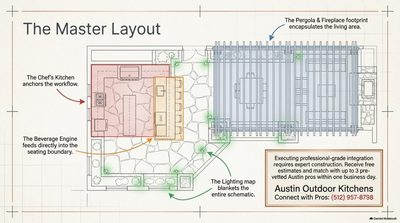
| The repeating structural module | 3,500 mm bay repeated across the grid | Frames are built to one module, so a distant job is identical to a nearby one |
| Overall run and edge detail | 5,060 mm run; 100 mm edge detail | Edge detailing is the first thing rushed when crews improvise on site |
| Drainage setting | Contour drawn at +10.00 | Water direction is a decision, not an accident of the backyard slope |
| Supervised lead | One accountable party for the whole scope | Removes the trade handoffs that cause most outdoor failures |
Read that table as a capture of decisions rather than a packing list. The bag count makes material substitution visible. The repeating module makes the build reproducible across properties. The edge detail and the contour are the two items most often dropped by an improvised local crew, and both are drainage-critical in Central Texas, where a hard freeze after a wet week finds every weak detail.
The outlying-suburb problem
Round Rock, Cedar Park and Georgetown share a pattern. They are close enough to be serviced by Austin crews, far enough that the crew's day is shaped by travel, and large enough that local labour is spread thin during peak season. When a project is assembled from local availability, the composition of the team changes from one stage to the next, and material comes from whichever yard is nearest rather than whichever specification was agreed.
A mobile specialty approach solves that by treating distance as a scheduling problem instead of a quality variable. The material load is planned from the plan's own numbers - at roughly 22 square feet of yield per 80 lb bag, the bag count for a given surface area is arithmetic - and the crew that starts the demolition is the crew that finishes the polish. For a homeowner that means fewer strangers on the property and no stage where nobody owns the work. For a small commercial operator it means a schedule that can be committed to a reopening date.
There is a scheduling consequence worth planning for. A mobile crew working across Austin, Round Rock, Cedar Park and Georgetown runs a route, so a weather day or a material delay affects a sequence of properties rather than one. The playbook's answer is rapid deployment with the crew's own equipment and sealed material, which shortens the window in which a site sits half-finished. What matters for a homeowner is that the stages which must not be interrupted - structural work and the waterproof layer - are planned as continuous work rather than as visits fitted around other jobs.
What to confirm before a crew deploys to your property
Ask for the material specification with the yield per bag stated, so the delivery can be verified on arrival - the checkpoints are in the authentication guide. Ask which crew members will be on site through the structural and waterproofing stages, since those are the stages where a changed face means a changed standard. Ask for the drainage direction in writing, and confirm it matches what actually happens on a rainy day. And ask who the single accountable party is, by name.
If you are comparing options across the metro, the cost calculator in the tools hub lets you price the same scope for different locations, and the outdoor architectural master plan covers the drawing that makes a distant job controllable in the first place.
Frequently asked questions about crew logistics
Is a travelling crew more expensive for a Georgetown project?
Travel is a line item, but it replaces two other costs: the rework that follows trade handoffs and the delay risk of assembling local crews at peak. Price the whole scope, not the mobilisation line.
Does material really come from off-site?
In the supervised model, yes - sealed branded material and the crew arrive together so the specification is controlled. That is what makes a batch number and a bag count meaningful on the day.
How is consistency maintained across different properties?
Through the drawing. A repeating 3,500 mm module, a stated run, an edge detail and a drainage contour reproduce the same build on different lots, which is exactly how the deck's commercial deployments stay uniform.
Plan the deployment, not just the build
The commercial playbook treats logistics as part of the specification, because a good build in one city and a rushed one in the next is not a standard. For Austin, Round Rock, Cedar Park and Georgetown, that means one crew, one material load and one accountable lead. Call (512) 957-8798 to check availability for your area, or read the Austin cost breakdown first to frame the budget.